| Work With Us |  |
Reflections and documentation about the environment, indigenous peoples, and sustainability of Bentara Papua's work in Papua.
Sasi Laut Nusmapi: When Papuan Local Wisdom Becomes Climate Action
06 January 2026 - by La Ode Muh Zidane Fajar
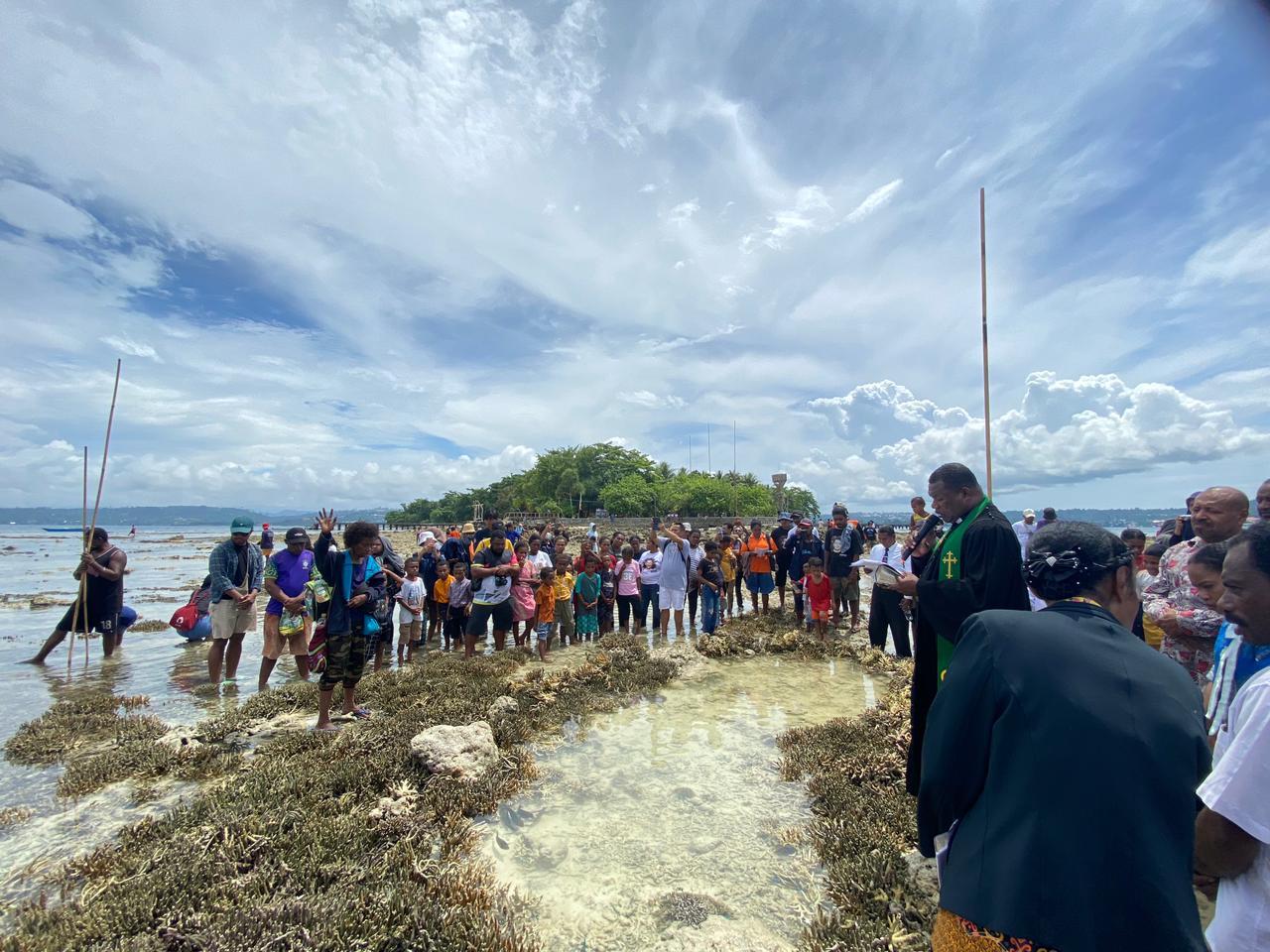
This photograph was taken during the reopening of sasi laut on Nusmapi Island, Manokwari. At first glance, it may appear as a simple scene: community members standing on exposed coral reefs during low tide, with a church leader leading a prayer. Yet for me, this image holds a much deeper story about humanity’s relationship with nature, about patience and trust, and about climate action rooted in Papuan local wisdom. Nusmapi is a small island located in Doreri Bay, Manokwari. Though modest in size, the surrounding sea is the heart of community life. For the people of Nusmapi, the ocean is not merely an economic space; it is their front yard, a classroom, and a place where relationships with nature are nurtured. From the sea, they harvest fish, shellfish, sea cucumbers, and other sources of livelihood. Like many coastal areas in Papua, Nusmapi faces increasing ecological pressure. Climate change, growing human activity, and uncontrolled exploitation have gradually affected marine ecosystems. These changes often come quietly through declining catches, smaller fish sizes, or unpredictable fishing seasons. In response, the people of Nusmapi read the signs of nature in their own way. Sasi emerges not only as a cultural tradition, but as a survival strategy and a form of local adaptation to environmental change. The sasi documented in this photograph was not spontaneous. It was imposed in April 2023 and reopened in May 2024, allowing the sea more than a year to rest. During this period, the community collectively agreed not to harvest certain marine resources. There were no fences, no surveillance cameras, and no armed patrols. What protected the sasi was shared commitment, customary values, and collective responsibility. This moment carries even greater meaning because the sasi was initiated by Eco Defender Manokwari, a youth led community group, in collaboration with PHMJ Bahtera Utrecht Church of Nusmapi. It sends a powerful message that climate action does not always originate from large-scale policies or advanced technology. In Nusmapi, climate action grows from young people choosing to care for and protect their living space. In the photograph, children, adults, women, and men stand side by side on the exposed reef. There is no visible hierarchy between leaders and community members. Everyone faces the same sea, which seems to witness a shared promise once made together, now fulfilled together. For me, sasi represents a form of climate action deeply rooted in Papuan context. By temporarily closing marine areas, ecosystems are given space to recover naturally. Fragile coral reefs regenerate, and marine species are given time to grow and reproduce. In the face of climate change and mounting pressure on marine resources, sasi offers a relevant and effective adaptation practice. Climate action is often discussed in terms of carbon emissions, global targets, or international conferences. In Nusmapi, however, climate action takes a simpler yet profound form: giving nature time. This photograph captures a moment when humans choose restraint not taking as much as possible, but pausing for the sake of sustainability. I see this moment as a meeting point between faith, tradition, and environmental care. The prayer led by the church is not merely a spiritual ritual, but a moral commitment to protect creation, resist greed, and think about future generations. In Papua, churches play a significant social role, and this collaboration demonstrates how faith-based values can align with environmental sustainability. The children standing at the front symbolize the true reason sasi exists. They may not yet understand the term “climate change,” but they will live with its consequences. By involving them early, sasi becomes a means of passing down values and environmental responsibility. This photograph also shows that young Papuans are not passive observers of the global climate crisis. In Nusmapi, youth take on roles as initiators, connectors, and guardians of values. Learning from their ancestors while engaging with contemporary challenges, they recognize that the sea is not only today’s resource, but tomorrow’s foundation of life. For me, sasi in Nusmapi is a quiet form of resistance against environmental degradation not loud or confrontational, but consistent. It teaches that sustainability does not need to be fast or grand, but collective and long-term. When the sasi was reopened in May 2024, it did not signal unrestricted harvesting. Instead, it served as a reminder that the sea had been given time to heal—and now it is humanity’s responsibility to maintain balance. This story from Nusmapi reminds us that the future of Papua’s seas is shaped by the small, collective choices we make today. |
Other Publications
|
Dapatkan Informasi dan Update Terbaru dari Kami


